Thursday, January 29, 2009

A glimmer of hope?

Posted by -dags at 1:02 AM 0 comments


The conflict in Gaza is not going to go away. There is not, nor will there be a quick-fix solution to the Israeli-Arab conflict. However, this does not mean that a solution is not possible. Since the declaration of the ceasefire on the 18th of January there have been both heartening and discouraging signs.

Firstly, the appointment of George Mitchell as the US envoy to the Middle East embodies the kind of coherent and pragmatic logic that many hope will define the Obama administration. Mitchell played a key role as a facilitator in the talks which led to the Good Friday agreement in Northern Ireland, and which have resulted in a power sharing executive, the symbolic reconciliation of Gerry Adams and Ian Paisley, and the disarmament of the major paramilitary groups. During the talks Mitchell won the respect of both sides through a patience which, although criticised by some at the time, proved ultimately successful. In an interview with the Guardian newspaper in 2007, George Mitchell set out the framework he used in Northern Ireland and one that, if applied, would bode particularly well for the Middle East (for an outline of this framework see this link) .

Another positive development is that the international community has taken a renewed interest in reviving the peace process in the Middle East. Indeed this could be one of the major positives Israel takes from this war, Tzipi Livni and Ehud Barak have widely criticised the UN and other international organisations for turning a blind eye towards Hamas rockets fired into Israel. The Israeli invasion of Gaza has created a situation where the international community can no longer stand idly by, and recent soundings about NATO patrols in the sea lanes near Gaza are one concrete example of a possible international intervention which could help the area move towards peace.

However, the signing of the ceasefire has not dictated an end to open hostilities. An Israeli soldier died in a bomb attack on the Israeli-Gaza border on Tuesday, an event followed by an eminently recognisable spiral of retaliatory attacks with Israeli first bombing targets in Gaza and then Hamas launching a missile into Israel. Hamas did not claim responsibility for the bomb attack and some sources attribute it to the group, World Jihad. This accusation highlights what will be a key challenge in any peace process; small groups of extremists who through acts of violence will attempt to derail any progress. Both Israel and Hamas will have to show restraint and take a long term viewpoint in this regard, an approach rendered significantly more difficult by Israel’s policy of deterrence which obliges it to respond disproportionately to any attacks.

The idea of a “media war” has gained increasing currency in regard to the Israeli-Palestinian conflict, with accusations from both sides about sinister media plots and hidden agendas, and Israel forbidding journalists from entering Gaza during the conflict. Debate surrounding media coverage has continued with the BBC and Sky television’s recent refusal to broadcast an emergency appeal for Gaza provoking widespread anger. Mark Thompson the director general of BBC cited the channel’s imperative to maintain its balanced and objective coverage of the conflict as the rationale behind the decision.

Any negotiations will require significant compromises. The question as to whether the war in Gaza has rendered these compromises more likely remains to be answered.

Monday, January 26, 2009

The “PIGS” of Europe.

Posted by -dags at 12:15 AM 0 comments


No, this is not an article about common agricultural policy or even about the often unjust nature of stereotypes, this article is about a tale of giddy greed followed swiftly a sobering dose of reality. Portugal, Ireland, Greece, and Spain are oft cited as examples of the wonders of EU membership and unfettered free markets. However, in recent times these five countries have been among the hardest hit by the financial crisis and deprived of the option of currency devaluation their situation looks set to deteriorate further.

Spain’s unemployment rate has recently hit 14.6, its current account balance deficit now stands at 10% of GDP and along with Greece and Portugal it has seen its debt rating downgraded by Standard and Poor’s. These figures and in particular the downgrades have contributed to the consternation and worry which clouds the horizon at the Irish ministry of finance. On the 30th of September the Irish government insured the deposits of the three major Irish banks, Bank of Ireland, Allied Irish Banks and Anglo Irish Bank in a bid to restore confidence in a banking system which has seen massive erosion of shareholder value and more recently a scandal involving the Chairman of Anglo Irish. Mr Fitzpatrick, had 87 million euro of loans from the bank which he failed to he had sought to hide from investors by temporarily transferring them between banks, and which were seemingly overlooked by successive financial audits and reviews.

Continued turbulence in Irish financial markets, and growing concerns about the financial viability of Anglo Irish in large part due to its excessive exposure to the property markets led to its nationalisation on the 15th of January. This nationalisation has led to further speculation regarding the future of the State’s two biggest banks whose share price has continued to slump. The decline of the Irish bank shares and the similar fortunes of property prices have led to unprecedented levels of wealth destruction, as these two held pride of place as “safe bets” for would be investors. The outlook for the Irish economy was not improved by comments by EU Economic and Monetary Affairs Commissioner Joaquin Almunia who declared last Monday that Ireland’s economy was likely to contract by 5 per cent this year, the second weakest performance in the EU, behind only Latvia.

The severity of this economic contraction ultimately depends on the government’s ability to re-inject liquidity into the markets through a resumption of bank lending. The current situation, and one which is not unique to Ireland, is that banks terrified by the extent of their exposure to future losses are simply not lending. Rather they are scrambling to raise capital in a bid to secure their own liquidity.

With the government reportedly looking at insuring the billions of euro of bad loans that BoI and AIB may have, as well as plans to move forward the recapitalisation of the two banks( in the form of 2 million euro of preference shares into each of the two) the government recognises its imperative to act. However, just as a seemingly unfailing faith in the gravity defying nature of Irish shares and property once drove their prices skyward, so now an apparently unflappable pessimism is dragging them back down to earth.

With the banks crying out for recapitalisation and government finances moving further and further into the red, reform is inevitable. Yet where. In a education system impaired by ballooning class sizes? A health system caving in under the weight of an increasingly needy population? Tough decisions will have to be made, and quickly.

Tuesday, January 20, 2009

An emblem of hope, and one of despair.

Posted by -dags at 3:31 PM 0 comments


Over the past few days the bleak economic forecasts, which have of late dominated media coverage, have been replaced with a much missed optimism. This wave of optimism, this audacity to see light where many see only financial ruin and depression has been generated by Barack Obama and his inauguration, scheduled to take place later today. Leadership in times of strife is of immense importance and many great leaders reputations have been forged amid turmoil and chaos, Winston Churchill became a symbol for resistance in war time Britain, Nelson Mandela for humanity in post apartheid South-Africa and FDR for an American return to health after the Wall Street crash of 1929.

Yet at this time of great optimism, the tale Barack Obama is juxtaposed with that of another politician, a politician who was also hailed by his people as a forebearer of change, an apostle of hope. This man's name is Robert Mugabe. For as Barack Obama prepares to enter the White House as America's 44th president so Mugabe clings to power in what remains of the country he once helped to liberate. Zimbabwe was once a shining example of African democracy with a productive economy and political liberty. Now, this Zimbabwe remains but a distant memory.

Today Zimbabwe has risen to infamy as the emobiment of the expression "Power corrupts, and absolute power corrupts absolutely". It's economy in tatters, even hyper-inflation seems insufficient to capture the concept of the recently introduced 100 trillion dollar bank note. Once the bread basket of Africa, following Mugabe's disastrous land reform program (see politically motivated land grab) there are now widespread food shortages. The recent outbreak of cholera which continues to rave throughout the country has resulted in a death toll fast approaching 2000.

Yet like the people of America did on the 4th November 2008, Zimbabwean's (under significantly less permissive conditions)also voted for change. Where the American people voted for Barack Obama they voted for Morgan Tsvangirai. However, the Zimbabwean people have been deprived of the change they voted for in the first round of election in 2008 (Morgan Tsvangirai's party the Movement for Democratic Change withdrew from the second round due to serious concerns about their own and their supporters safety). Mr Mugabe, faced with mounting international pressure agreed to a power sharing government but talks regarding this option collapsed in the face of Mugabe's intransigence with regard to key industries and in particular control of the police and the army. On Friday as Barack Obama was readying himself for his journey in the footsteps of Abraham Lincoln, Morgan Tsvangirai returned to Zimbabwe for the first time in two months to try and bridge the political impasse.

Yesterday, monday the 19th of january, as the world waited with baited breath to be once again enthralled by the rhetorical genius of its new favourite son, Mr Tsvangirai proclaimed the day "the darkest day of our lives” for those hopeful of political change in Zimbabwe, as talks on a new coalition government ended in failure.

Saturday, January 17, 2009

Third level reform in Ireland.

Posted by -dags at 12:44 AM 1 comments
Ireland’s current system of free third level education is undoubtedly going to come to an end. We have enjoyed a university education courtesy of the government since fees were abolished in the mid 1990s but with such a bleak economic outlook and university funding having been slashed, it seems as if we are are left with little or no choice in the matter.

The main impetus behind fees is obviously to make capital available to the university which they subsequently invest into developing the infrastructure and paying day to day expenses such as the academics’ salaries. But at the moment in Irish universities, due to funding cuts people are beginning to lose their jobs, there is zero investment in infrastructure and class hours are being condensed. This is not what a university education should be based on, budget cuts and mediocrity.

Hence why we need fees to cover these costs and to help bring our colleges up to international standards. It is common practice around the world, most notably in the USA, a country that has the highest concentration of top universities in the world. Should we not try to mimic systems like this and begin producing students that can compete with the high calibre of graduate that they produce?

Irish students need to be informed that they could potentially receive an improved education, one that could compete with those from the USA or the UK. We need to stop being so vehemently opposed payment of fees for our education and think about it in the long term, as an investment rather than an expense.

-Post by Michael Moran student of European studies at University College Cork, currently studying in Bordeaux III.

A transformative president?

Posted by -dags at 12:29 AM 2 comments


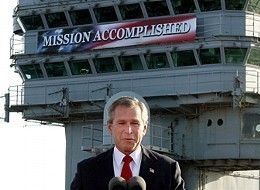
George W Bush saw himself as playing a transformative role in history. A man of immense ambition, he saw himself not only instigating a new era of Republican supremacy but also carving out a new America. Yet this man of ambition, endorsed by the Economist magazine and twice elected to their highest office by the American people leaves a legacy which although transformative is not that which Bush or indeed the American people had hoped for.
In his farewell speech Bush spoke of a world transformed. A world of “young democracies” increasingly well equipped to deal with the threats ranged against them and an America enjoying a reformed Medicare system and on the cusp of a bright future. This vision is an evident distortion of a reality far less auspicious. Bush is no stranger to criticism and beyond the redoubt of Fox News and the minds of his most devout followers his presidency has been widely condemned as a disaster. Indeed an informal poll of 109 history professors by George Mason University found that 98 percent considered him as a failed president.

The most prominent example of this failure is the US invasion of Iraq. The Bush presidency made Iraq the centre of a “War on terror”, in an audacious plan to create a democratic oasis in the Middle East, which it was hoped would then spread democratic ideals and values. However, the approach to the war as well as the intelligence according to which the decision to go to war was justified were fundamentally flawed. More than five years down the line the “fledgling democracy” that is Iraq has become a battlefield fuelled by sectarian hatred which has diverted badly needed resources from Afghanistan further undermining regional stability and compounding Iranian influence.

However, any analysis of Bush’s presidency must look at domestic as well as foreign policy. Bush’s two central boasts on this front revolve around taxation and a reform of Medicare. Bush adopted what can be termed the Reagonomics approach to taxation which dictates that by decreasing taxation you can actually stimulate an increase in total receipts by boosting in economic activity. Although this policy can be economically justifiable, Bush’s policy of tax cuts remained superficial as it failed to tackle a taxation system widely described as an abomination and which encourages spending while penalising investment and saving. This fiscal generosity twinned with his reform of the Medicare drug benefit system (the single most expensive expansion of Medicare since its creation in 1965), amount to a considerable black hole in America’s finances. While he inherited a budget surplus of $128 billion in 2000, this was dispatched with by 2003 and current conservative estimates foresee a deficit of $750 billion in 2009. For a comprehensive review of Bush’s economic policy see The 10 Trillion Dollar Hangover: Paying the Price for Eight Years of Bush " by Linda Bilmes and Joseph Stiglitz.

What of Bush’s desire to initiate an era of Republican dominance in American politics? The political philosophy espoused by Bush, Cheney and company is in crisis. Iraq had already challenged the neo-conservative foreign policy before the financial meltdown discredited its economic policy (although blame for this lies not solely at the feet of Bush) and Katrina highlighted the administrations gross incompetence.

George W Bush truly was a transformative president; he transformed much of the world’s image of America, his country’s finances, and with help from a young man born of a Kenyan father and a Kansan mother the fortunes of the Democratic Party. His farewell address although it tries it best will not succeed in revisionism. Bush’s abysmal record speaks for itself and looking forward, I feel history will frown, rather than smile, on its Texan son.

Tuesday, January 13, 2009

"The Holocaust Is Over, We Must Rise From Its Ashes,"

Posted by -dags at 8:31 PM 2 comments
"If you are a bad person, a whining enemy or a strong-arm occupier, you are not my brother, even if you are circumcised, observe the Sabbath, and do mitzvahs. If your scarf covers every hair on your head for modesty, you give alms and do charity, but what is under your scarf is dedicated to the sanctity of Jewish land, taking precedence over the sanctity of human life, whosever life that is, then you are not my sister. You might be my enemy. A good Arab or a righteous gentile will be a brother or sister to me. A wicked man, even of Jewish descent, is my adversary, and I would stand on the other side of the barricade and fight him to the end."
-former Israeli Knesset speaker and ex-Jewish National Fund chairman Avraham Burg

The Israeli-Palestinian conflict polarises opinion. Friends of mine, normally rational and reserved, metamorphose into rabid dogs as soon as the topic is broached. Behind this transformation lies a number of reasons. Often people feel an ethnic or religious affinity with one of the two groups, and they feel questioning the actions of either side is an attack on their identity. Some identify with an underdog they see as the victim of Israeli US backed neo-imperialism, while yet others see only a people who after more than two thousand years of persecution remain surrounded by people who deny their state’s right to existence.

Each can back his or her point of view by pointing to atrocities perpetrated by the “others”, by opportunities for peace snubbed or ceasefires violated. Some, wary of over-simplification recognise that often amidst the debate the plight of simple humanity lies forgotten, of Israeli or Palestinian children who will never be adults, of houses lost and businesses ruined.

Reject temptation, do not be drawn in by what Oscar Wilde termed the “common catch cry of the clown”, the accusations of terrorism or imperialism belie a more complex reality. Recognise this, embrace the fact that this conflict finds its roots in the annals of history and that few if any summaries can capture its true nature. However, don’t shy away from the challenge. Form an informed opinion. Read beyond glib commentaries of current events for this conflict is and will remain a central issue on the world stage.

If you are aware of any links to good writers, sites or articles who deal with this conflict please post a link or reference to them in the comments section.

Sunday, January 11, 2009

Missiles for Peace?

Posted by -dags at 2:48 PM 0 comments

The bloody conflict that has characterised much, and some would say all, of Israel’s existence is back on the front page. The fragile ceasefire between Hamas and Israel which came into effect in June 2008 lies burning in Gaza. This ceasefire has been repeatedly flouted by Hamas, who have continued to launch missiles into southern Israel, despite frequent Israeli declarations that these attacks would be met by a military response. A military response has followed. It began on the 27th of December with aerial bombardments and was followed on the 3rd of January by a ground offensive.

Amid recent news coverage I have been struck by the absence of an analysis of motivations. Why did Hamas continue to launch down a path it was fully aware would lead to a broadening of the conflict? And why does Israel continue to centre its defence policy based on a military doctrine of disproportionality.
Hamas refuses to acknowledge Israel’s right to existence, and it is this refusal twinned with what it perceives as the continued military and economic oppression of the Palestinian people that motivates its continued militancy. It feels that the only language Israel understands is Fear and Violence. Also it is aware that any Israeli incursion into Gaza will result in civilian casualties which will help polarise opinion in favour of the zealots among Hamas at the expense of Fatah, an opinion echoed by British Home Secretary Jacqui Smith on a recent visit to Turkey.

Israel has remained faithful to the idea that any provocation must be met with greater force. This dogma which has succeeded in securing the existence of Israel until this point has been complicated by the emergence of non-state actors such as Hezbollah and Hamas who are harder to effectively target. Israel believes that by demonstrating its military strength it conveys an image of intransigence which sends a clear and succinct message to its neighbours; we, are here to stay. However, its military operation in the Lebanon in 2006 projected an image far from that of an omnipotent military power.
Could Hamas’ breaching of the ceasefire and the subsequent Israeli ground offensive in Gaza serve to further undermine the myth of invincibility which serves as Israel’s most cherished cloak?
 

Recent ruminations. Copyright 2009 Reflection Designed by Ipiet Templates Image by Tadpole's Notez