
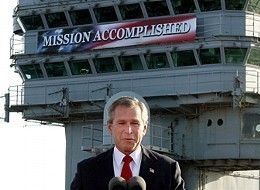
George W Bush saw himself as playing a transformative role in history. A man of immense ambition, he saw himself not only instigating a new era of Republican supremacy but also carving out a new America. Yet this man of ambition, endorsed by the Economist magazine and twice elected to their highest office by the American people leaves a legacy which although transformative is not that which Bush or indeed the American people had hoped for.
In his farewell speech Bush spoke of a world transformed. A world of “young democracies” increasingly well equipped to deal with the threats ranged against them and an America enjoying a reformed Medicare system and on the cusp of a bright future. This vision is an evident distortion of a reality far less auspicious. Bush is no stranger to criticism and beyond the redoubt of Fox News and the minds of his most devout followers his presidency has been widely condemned as a disaster. Indeed an informal poll of 109 history professors by George Mason University found that 98 percent considered him as a failed president.
The most prominent example of this failure is the US invasion of Iraq. The Bush presidency made Iraq the centre of a “War on terror”, in an audacious plan to create a democratic oasis in the Middle East, which it was hoped would then spread democratic ideals and values. However, the approach to the war as well as the intelligence according to which the decision to go to war was justified were fundamentally flawed. More than five years down the line the “fledgling democracy” that is Iraq has become a battlefield fuelled by sectarian hatred which has diverted badly needed resources from Afghanistan further undermining regional stability and compounding Iranian influence.
However, any analysis of Bush’s presidency must look at domestic as well as foreign policy. Bush’s two central boasts on this front revolve around taxation and a reform of Medicare. Bush adopted what can be termed the Reagonomics approach to taxation which dictates that by decreasing taxation you can actually stimulate an increase in total receipts by boosting in economic activity. Although this policy can be economically justifiable, Bush’s policy of tax cuts remained superficial as it failed to tackle a taxation system widely described as an abomination and which encourages spending while penalising investment and saving. This fiscal generosity twinned with his reform of the Medicare drug benefit system (the single most expensive expansion of Medicare since its creation in 1965), amount to a considerable black hole in America’s finances. While he inherited a budget surplus of $128 billion in 2000, this was dispatched with by 2003 and current conservative estimates foresee a deficit of $750 billion in 2009. For a comprehensive review of Bush’s economic policy see The 10 Trillion Dollar Hangover: Paying the Price for Eight Years of Bush " by Linda Bilmes and Joseph Stiglitz.
What of Bush’s desire to initiate an era of Republican dominance in American politics? The political philosophy espoused by Bush, Cheney and company is in crisis. Iraq had already challenged the neo-conservative foreign policy before the financial meltdown discredited its economic policy (although blame for this lies not solely at the feet of Bush) and Katrina highlighted the administrations gross incompetence.
George W Bush truly was a transformative president; he transformed much of the world’s image of America, his country’s finances, and with help from a young man born of a Kenyan father and a Kansan mother the fortunes of the Democratic Party. His farewell address although it tries it best will not succeed in revisionism. Bush’s abysmal record speaks for itself and looking forward, I feel history will frown, rather than smile, on its Texan son.
2 comments on "A transformative president?"
Darragh,
Awesome Blog - had no idea you ran this! May I comment on this entry:
George W. Bush's eight years in office were certainly littered with mistakes, both in policy and politics, and often times in both areas at once: his economic policies, as you rightly noted, left the U.S. with an outsize budget deficit, and were likewise an embarrassment to fiscal conservatives, tarnishing one of the few aspects of the Republican 'brand' that still appealed to centrist voters. Bush wore out the American people's patience for both him and the Republican Party after two recessions and two wars, granting much opportunity to the democrats, given that they could find the right man this time around (they failed in 2004).
But Bush's comment that history will be his ultimate judge -- implying that his legacy might be interpreted as something other than a complete disaster -- still appeals to me as having a slimmer of plausibility.
I'll risk making yet another bold pronouncement that may be difficult to defend: I think that September 11, 2001 will serve as a dividing line between two distinct eras in the US. Perhaps that seems obvious, but I think 9/11 created a permanent, shock-induced shift in the American zeitgeist. 9/11 put a definitive last bullet into Fukuyama's "End of History" and lent much credit to Védrine's (how choice) Hyperpuissance-ism. On ground level, Americans felt for the first time their vulnerability, and that feeling has and will continue to shape generations of voters and policymakers. In contrast, I don't believe that 9/11 caused as severe of a shift in Europe, where the weight of history has long been a constant reality in policy-making and in everyday people's mentalities.
My point is that the 43rd President was elected before 9/11, by a people with completely different concerns and realities than before. He was a man who was anticipating a relatively calm time in office, during which he could have instituted certain neoconservative policies and perhaps followed through on some of his campaign promises. As this famous shot (scroll down, you'll know which photo I'm referencing when you see it, http://morris.blogs.nytimes.com/2009/01/25/mirror-mirror-on-the-wall/) shows, the man was completely unprepared for what happened that day.
What followed for the next 7 years was an unsure and unprecedented path for an unprepared President, who, despite a seismic shift of conditions, still bore the same chief responsibility of ensuring the security of his country. And a change of conditions was certainly no excuse – but when he swore to fulfill his duties no matter what came along, no one could have anticipated even a variation of the future, a fact which itself demonstrates the stark contrast between the pre- and post- 9/11 worlds.
Because America and the rest of the free world enjoys living with developed democracy and civil society, it didn't take long for America (and everyone else) to shift out of record-breaking approval for Bush to steep criticism of the administration's arguably questionable policies. The Homeland Security Act, the wars, etc. In retrospect, many of the decisions that were made -- those regarding torture for instance -- were certainly not in line with what America stands for, or with what is legal, or with what should be permissible. I don't want to be a relativist and proceed to say that 'given the conditions, however, they were necessary evils' - because save for moral relativism, evil can never be necessary. Yet, as Cheney has recently begun to voice, we can begin to understand the decision making process that occurred and why it was, in fact, necessary, and we can also begin to appreciate the results. Necessary, but also wrong: a concept that people cannot cope with and that is political suicide.
The oft-used argument during the '04 election by the Bush camp was that there had been no repeat 9/11, demonstrating the administration’s success. I believe that argument has still not been appreciated for its potential worth because it is a negative statement that is difficult to prove. But what makes Bush's comment regarding his legacy more justifiable in this context is that with time, we will undoubtedly gain greater access to the records we cannot now see. And if Bush was being sincere and not just making a political cheap shot , that statement will suddenly turn from a negative into a positive: The Bush administration proactively thwarted multiple terrorist threats on the United States and disassembled, to a large extent, international terrorist networks. We ought to remember as well that it is easy to criticize a successful security policy that just happens to be morally undesirable. With a threat eliminated, we can go back into history in moral reverse to attempt to undo the wrongs and leave everyone happy, save Bush and his associates, who conveniently become scapegoats for a dark and unsure period of history. "When heroes arise who take those difficult duties on themselves, it is tempting for the rest of us to turn our backs on them, to vilify them in order to protect our own appearance of righteousness. We prosecute and execrate the violent soldier or the cruel interrogator in order to parade ourselves as paragons of the peaceful values they preserve." That line comes from this interesting piece from the WSJ: http://online.wsj.com/public/article_print/SB121694247343482821.html
Perhaps instead of judging him positively or negatively, history will provide a nuanced assessment of Bush’s legacy in office because it transcended two ideologically separate periods. America will learn from Bush’s presidency and his many mistakes. America will never be so careless in choosing its President – voters have an enlarged imagination, a greater scope of possibilities under which they must feel comfortable with a particular candidate. But America may also come to appreciate the Bush administration simply for its preservative success, which will slowly unfold over time. Bush will never be a celebrated President – but he will also likely not be a hated one. That his legacy will continue to be debated is certain – and that fact alone indicates that there will be no hard answers for time to come.
George,
Thank you for your comment, it is most welcome and both informative and thought provoking.
I agree with you that the official secrets act may be preventing the publication of documents which which would bolster the security record of the Bush administration. If such evidence does emerge it would surely rehabilitate, to some degree, Bush's reputation as a President. However, I feel that the recent revelations on the use of torture show that this argument can swing both ways. They also underline the fact that whatever succeses his government may have had in preventing terrorist attacks the damage which his policies incurred on the American reputation, its "soft power", have been severly weakened. This line of thought leads to a cost-benefit which is not only extremely complex but also almost impossible to measure! Ultimately, the weight you attribute to the above factors is largely dependant on the prism through which you choose to view IR.
The point you make about negative statements is very pertinent and oft overlooked. Having just finished the "Black Swan", this unfair distribution of blame/praise has suddenly become much more visible.
I feel that the idea of a "preservative success" is an interesting one, but may ultimately be undone, or prevented, by the fact that Bush oversaw a relative decline of American power and influence.
I must admit that I rather enjoyed the WSJ article, it raises some interesting questions which while aptly illustrated by Batman force us into a zone in which few of us feel comfortable. A place where moral absolutism suddenly discovers that its borders are blurred and that the articulation of our values demands real reflection and evaluation. The question for me is whether the type of reflection these questions demands was offered by the Bush administration? Or whether the creeping influence of religious self-righteousness and a penchant for Manichean reductionism resulted in a superficial policy making process which will ultimately be regretted?
Not being particularly au fait with US domestic politics, I am wondering whether the Republican party may increasingly view it as in their interest to distance themselves from the Bush legacy and in doing so deprive him of his most ardent defenders?
Darragh
Post a Comment